
Views: 13
Orangutan: Intelligence and Life in the Rainforest


11
Wildlife & Nature | Primates | Rainforest Conservation
Orangutans are among the most intelligent animals on Earth. With their reddish-orange fur, remarkable problem-solving abilities, and close family bonds, these great apes offer a fascinating glimpse into the complexity of life in tropical rainforests.
Native to the islands of Borneo and Sumatra in Southeast Asia, orangutans spend much of their lives high in the forest canopy. Their ability to use tools, learn from experience, and adapt to their surroundings makes them extraordinary members of the animal kingdom.
1. Meet the Orangutan
The name orangutan comes from Malay and Indonesian words meaning “person of the forest.”
Orangutans belong to the genus Pongo and are the only living great apes native to Asia.
There are three recognized species:
| Species | Scientific name | Habitat |
|---|---|---|
| Bornean orangutan | Pongo pygmaeus | Borneo |
| Sumatran orangutan | Pongo abelii | Northern Sumatra |
| Tapanuli orangutan | Pongo tapanuliensis | Batang Toru region, Sumatra |
All three species are classified as Critically Endangered.
Orang Utan Republik Foundation
+1
2. Extraordinary Intelligence
Orangutans are capable of complex thinking, learning, and problem-solving.
They can use branches and leaves as tools, remember where food is located, and learn important survival techniques by watching other orangutans.
Some populations have been observed using sticks to extract insects or seeds. Their intelligence is especially remarkable because many of these behaviors are learned rather than entirely instinctive.
Researchers also study how orangutans communicate through gestures, facial expressions, and vocalizations.
3. Life High Above the Forest Floor

Orangutans are the largest tree-dwelling mammals. Their unusually long arms, powerful hands, and grasping feet allow them to move through dense vegetation.
Unlike many monkeys, orangutans do not have tails.
Every evening, they typically construct a sleeping nest by bending and weaving branches together. These elevated nests provide a place to rest among the trees.
Although they spend most of their time in the canopy, Bornean orangutans sometimes travel along the forest floor.
4. What Do Orangutans Eat?
Orangutans eat a varied diet, with fruit playing a particularly important role.
Their food includes:
- Wild figs, durians, and other tropical fruits
- Young leaves and shoots
- Tree bark and flowers
- Insects and occasionally bird eggs
- Seeds and other plant materials
Their feeding habits also benefit the rainforest. By consuming fruit and dispersing seeds, orangutans help trees regenerate and maintain forest biodiversity.
WWF
+1
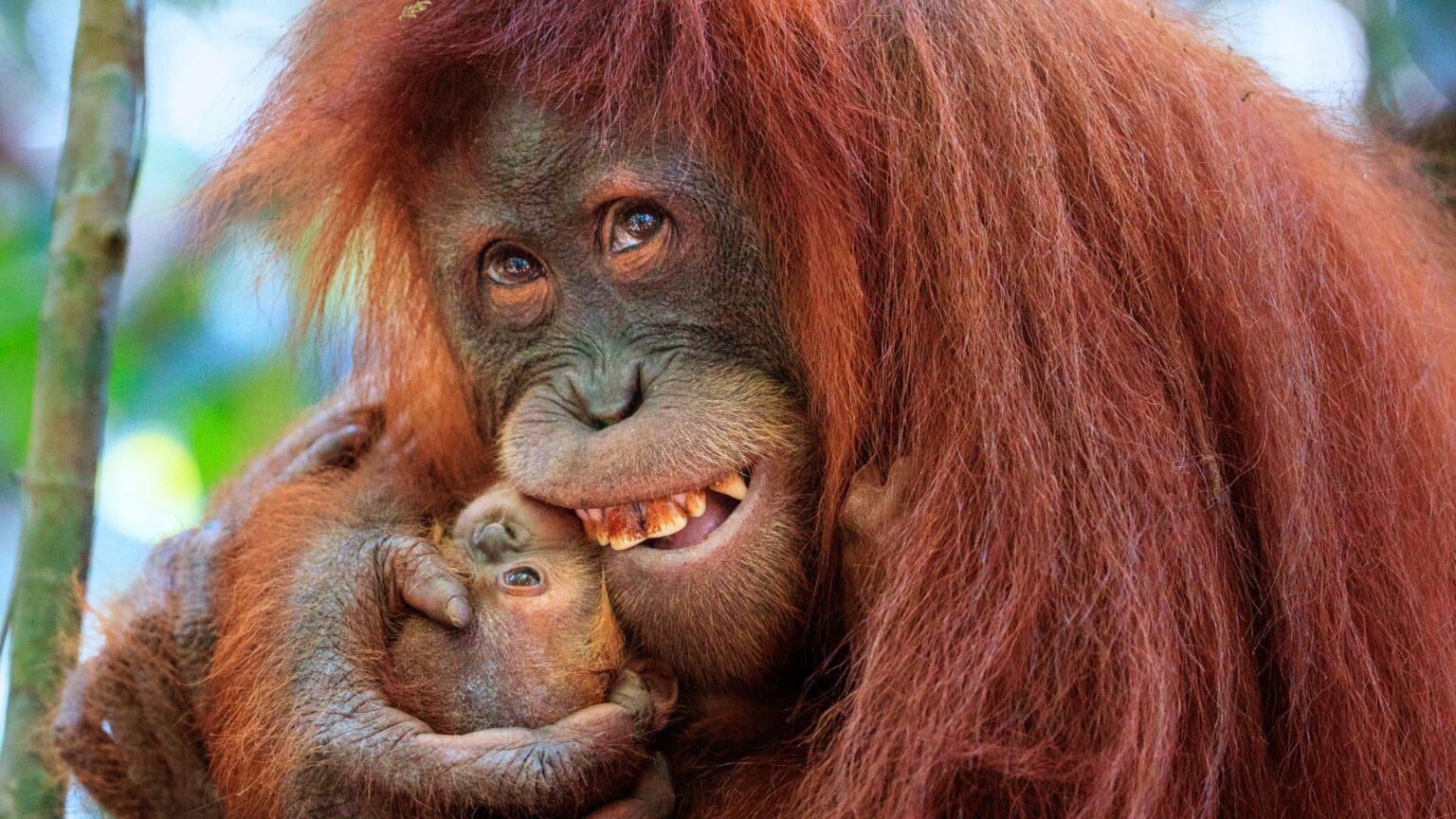
5. The Remarkable Bond Between Mother and Baby

Mother orangutans demonstrate some of the longest periods of maternal care among mammals.
Young orangutans may remain with their mothers for seven to eight years, learning how to find food, climb safely, construct nests, and navigate the rainforest.
Because females reproduce slowly, the loss of even a relatively small number of breeding females can have serious consequences for wild populations.
6. Are Orangutans Social Animals?
Unlike chimpanzees, which often live in large social communities, orangutans are generally semi-solitary.
Adult males commonly travel alone, while mothers stay closely connected to their dependent offspring.
However, orangutans are not completely isolated. They may interact at feeding locations, communicate across the forest, and establish relationships with other individuals.
Their social behavior varies between species and habitats.
7. The Threats Facing Orangutans

Despite their intelligence and adaptability, orangutans face severe environmental threats.
The major dangers include habitat destruction, forest fragmentation, agricultural expansion, illegal hunting, and the illegal wildlife trade.
One particularly concerning issue is their slow reproductive rate, which makes population recovery difficult.
A scientific assessment published in September 2026 estimated approximately 11,694 Sumatran orangutans and 716 Tapanuli orangutans, with uncertainty ranges around both figures. These estimates highlight the urgency of protecting their remaining habitats.
ScienceDirect
+1
8. Why Orangutans Matter to the Rainforest
Orangutans are sometimes described as gardeners of the forest.
As they move through the canopy and consume fruits, they disperse seeds across large areas, supporting the growth of new trees.
Protecting orangutans also helps protect other rainforest wildlife, including birds, insects, reptiles, and countless plant species.
Their survival is closely connected to the health of Southeast Asia’s tropical forests.
9. How Can We Help Protect Orangutans?
Conservation requires protecting existing forests, restoring damaged habitats, preventing illegal wildlife trafficking, and supporting communities that live near orangutan habitats.
Consumers can also support responsible production and sourcing of agricultural commodities, including palm oil, while demanding stronger environmental safeguards.
Supporting credible conservation organizations and responsible wildlife tourism can contribute to longer-term protection efforts.
10. Fascinating Orangutan Facts
Intelligent problem-solvers
Orangutans can use tools and learn complex behaviors through observation.
Tree-dwelling specialists
Their long arms and grasping feet are highly adapted for life in forest canopies.
Strong maternal bonds
Young orangutans depend on their mothers for many years.
Essential seed dispersers
Their fruit-rich diet helps forests regenerate naturally.
Conclusion
Orangutans are far more than remarkable rainforest animals. They are intelligent, adaptable great apes whose survival reflects the health of some of the world’s most important tropical ecosystems.
Understanding their behavior, family relationships, and ecological role helps explain why protecting orangutans is essential for conserving rainforest biodiversity.
By preserving their habitat, we help ensure that future generations can continue to witness these extraordinary creatures living freely in the wild.
WordPress SEO details
SEO title
Orangutan: Intelligence, Behavior and Rainforest Life
Slug
orangutan-intelligence-life-rainforest
Meta description
Discover orangutan intelligence, tool use, rainforest habitat, family bonds, diet, and the conservation challenges facing these endangered great apes.
Focus keyphrase
orangutan intelligence
Category
Animals / Primates
Image alt text
Wild orangutan in a tropical rainforest canopy in Southeast Asia
Copy-ready WordPress tags
Orangutan, Orangutan Intelligence, Bornean Orangutan, Sumatran Orangutan, Tapanuli Orangutan, Great Apes, Rainforest Wildlife, Animal Intelligence, Wildlife Conservation, Endangered Species, Orangutan Habitat, Primates, Tropical Rainforest, Animal Behavior, Biodiversity
Copy tags
Suggested authoritative references: Smithsonian National Zoo · World Wildlife Fund · 2026 population assessment
Image previews are visual references; check licensing and usage permissions before embedding them in a published article.