
Views: 9
Komodo Dragon: Biology of the World’s Largest Living Lizard
Wildlife & Nature | Reptiles | Animal Biology
Komodo Island: What to Know Before Visiting Indonesia’s Dragon Kingdom
What Do Komodo Dragons Look Like?
Destination Dragon: Why You Should Visit Komodo Island | Tatler Asia
11
The Komodo dragon (Varanus komodoensis) is the largest living lizard on Earth. Native to a handful of Indonesian islands, this remarkable reptile combines enormous size, powerful jaws, venom-producing glands, and highly developed chemical senses.
Despite its prehistoric appearance, the Komodo dragon is a highly specialized modern predator, playing a vital role in the ecosystems of its island habitat.
Komodo Dragon: Quick Facts
Scientific name
Varanus komodoensis
Family
Varanidae
Maximum verified length
3.13 m
Typical wild adult weight
70 kg
Estimated lifespan
Around 30 years
Conservation status
Endangered
Size and lifespan figures: Smithsonian National Zoo. Conservation status: IUCN Red List. National Zoo+1
1. Physical Characteristics and Adaptations
Komodo dragons possess several anatomical features that make them highly effective predators.
- Muscular bodies: Strong limbs, powerful neck muscles, and long tails provide stability and strength.
- Serrated teeth: Curved, sharp-edged teeth tear flesh during feeding.
- Armored skin: Tough scales reinforced by small bony deposits called osteoderms offer additional protection.
- Strong claws: Used for digging, gripping, and defense.
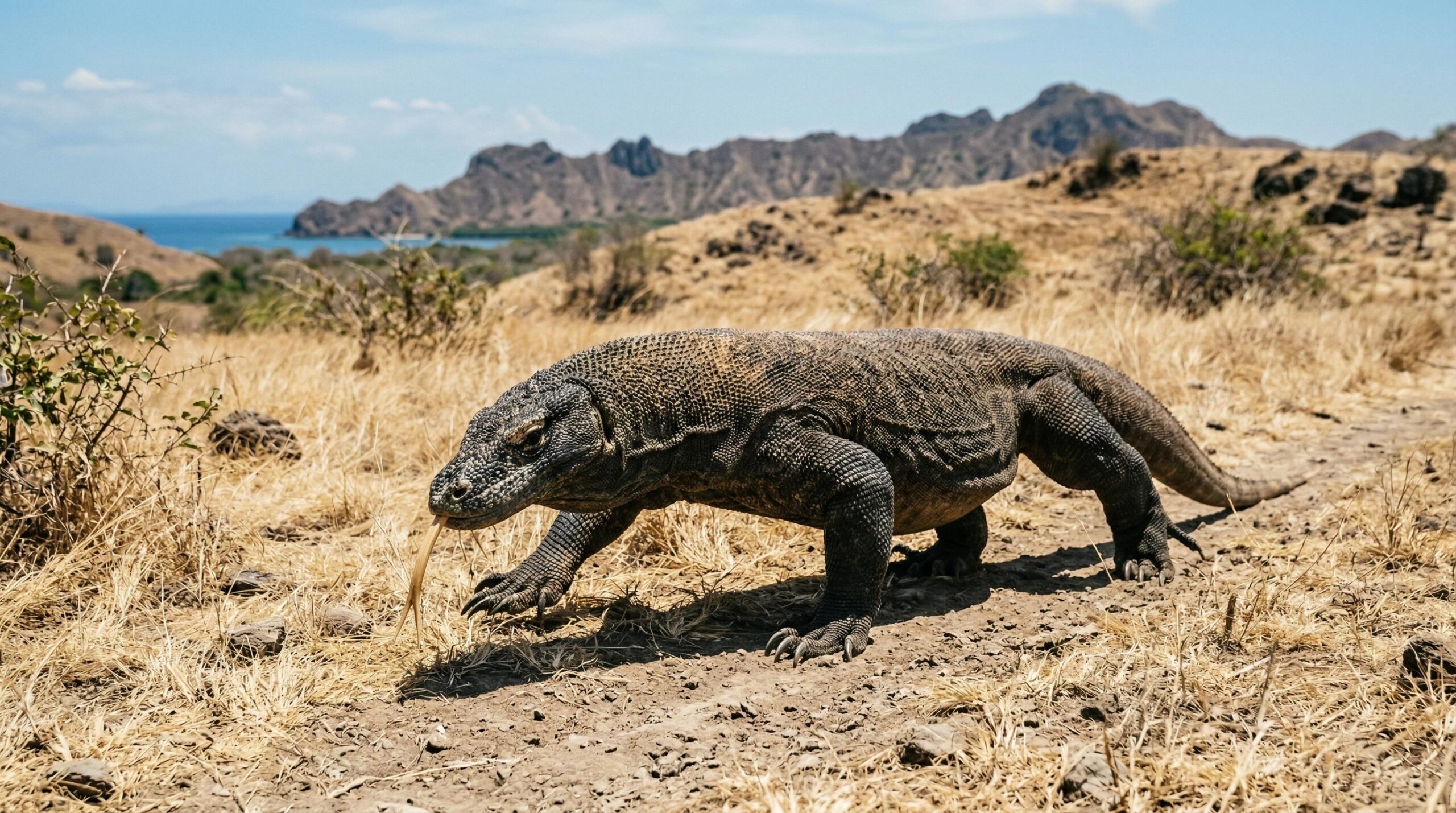
- Forked tongue: Collects chemical particles from the environment to locate food and detect other animals.
Males are generally larger and heavier than females. Their immense size helps adults dominate the food chain, while younger dragons depend on agility and climbing ability to survive. San Diego Zoo Animals & Plants+1
2. Habitat and Geographic Distribution
Komodo Island: What to Know Before Visiting Indonesia’s Dragon Kingdom
Komodo dragon in Komodo National Park on Rinca Island in Indonesia
Komodo National Park – Gallery – UNESCO World Heritage Centre
8
Komodo dragons naturally occur on a small group of islands in eastern Indonesia, including Komodo, Rinca, Flores, Gili Motang, and Nusa Kode.
They inhabit tropical savannas, dry grasslands, scrublands, and forests. These environments provide opportunities for hunting, nesting, basking in sunlight, and finding shelter during the hottest parts of the day.
Because they are ectothermic, Komodo dragons depend on external heat sources to regulate their body temperature.
3. Hunting, Diet, and Venom
Komodo dragons are both active predators and scavengers. Their diet includes deer, wild boars, smaller reptiles, birds, and carrion. Large adults may attack substantially bigger animals.
Their hunting strategy combines patience, camouflage, powerful bites, and sharp teeth.
A particularly fascinating adaptation is their venom system. Glands in the lower jaw produce substances that can interfere with blood clotting and contribute to lowered blood pressure, worsening the effects of bite injuries.
The older belief that Komodo dragons kill primarily through bacteria in their mouths is an oversimplification. Mechanical injury, blood loss, and venom are important components of their predatory biology. National Zoo+1
4. Extraordinary Sense of Smell
The Komodo dragon repeatedly flicks its long, forked tongue to collect chemical particles from the air and ground.
These particles are analyzed using the vomeronasal, or Jacobson’s, organ in the roof of the mouth.
This allows dragons to track prey, identify carrion, and detect chemical signals. Under favorable conditions, they can detect decaying meat several kilometers away. National Zoo
5. Reproduction and Life Cycle
How to track your (Komodo) dragon
A First for the Bronx! 6 Komodo Dragons Hatch at Bronx Zoo > Newsroom
Baby Komodo Dragons Go On Show At London Zoo
11
Female Komodo dragons lay eggs, often in excavated nests or modified mound nests. Incubation lasts approximately eight to nine months.
Young dragons face significant dangers, including predation by adult Komodo dragons. Juveniles therefore spend considerable time climbing trees, where they can feed and avoid larger individuals.
One of their most unusual biological abilities is parthenogenesis, a form of reproduction in which females can produce offspring without fertilization by males. This rare reproductive strategy has been documented in captive Komodo dragons. National Zoo+1
6. Ecological Importance
As apex predators, adult Komodo dragons help shape prey populations and ecological interactions within their island environments.
They also consume carrion, contributing to the recycling of nutrients through local ecosystems.
Their survival is closely connected to the health of prey populations and the availability of suitable nesting and hunting habitats.
7. Conservation and Threats
The Komodo dragon is classified as Endangered by the IUCN. Its restricted geographic distribution makes the species especially vulnerable to environmental changes.
Major conservation concerns include habitat loss, climate change, human activity, and declining availability of prey.
The IUCN assessment reports approximately 1,383 mature individuals, based on its 2019 evaluation published in 2021. This should not be interpreted as a new population census for 2026. IUCN Red List of Threatened Species
Protected areas such as Komodo National Park, habitat management, scientific monitoring, and anti-poaching enforcement are essential for its long-term survival.
Conclusion
The Komodo dragon is an extraordinary example of reptilian adaptation and evolutionary specialization. Its combination of size, sensory abilities, defensive armor, and predatory behavior makes it one of the most fascinating animals alive today.
Protecting this unique species also means preserving the ecosystems of the Indonesian islands where it has evolved.
WordPress SEO Details
| Field | Copy-ready content |
|---|---|
| SEO title | Komodo Dragon: Biology, Venom, Habitat & Facts |
| Focus keyword | Komodo Dragon |
| Slug | komodo-dragon-biology-facts |
| Category | Animals → Reptiles |
| Image alt text | Komodo dragon in its natural Indonesian habitat |
Meta description:
Discover Komodo dragon biology, size, venom, hunting techniques, reproduction, habitat, and conservation facts about the world’s largest living lizard.
Copy
WordPress Tags:
Komodo Dragon, Varanus komodoensis, Largest Lizard, Monitor Lizard, Reptile Biology, Venomous Lizards, Indonesian Wildlife, Komodo National Park, Apex Predators, Animal Adaptations, Endangered Species, Wildlife Conservation
Copy tags
Create copy-ready WordPress HTML with picturesCreate a Komodo Dragon post thumbnailCreate a one-page Komodo Dragon infographic