Views: 14
The Arabian oryx is one of the desert’s most striking mammals: a pale antelope with dark facial markings and long, slender horns. Its story is equally distinctive. After disappearing from the wild in the twentieth century, the species returned through breeding, reintroduction and sustained protection. It remains a powerful example of what conservation can achieve—and why recovery requires continuing work.
This guide explores Oryx leucoryx, its desert adaptations, herd life and conservation in the UAE and wider region. Below, ten photographs show adults, a calf and family groups, while three archival videos add expert and conservation perspectives.
Arabian oryx facts at a glance
| Scientific name | Oryx leucoryx |
|---|---|
| Animal group | Antelope, family Bovidae |
| Appearance | Mainly white coat, darker face and leg markings |
| Horns | Long and slender; present in males and females |
| Habitat | Deserts and semi-deserts |
| Weight reference | Up to 80 kg in EAD’s species profile |
| Conservation status | Vulnerable, as listed in EAD’s species profile |
The Environment Agency – Abu Dhabi species account provides the identification and local conservation reference. A status category describes extinction risk; it does not mean every population has the same size or management needs.
How to recognise an Arabian oryx
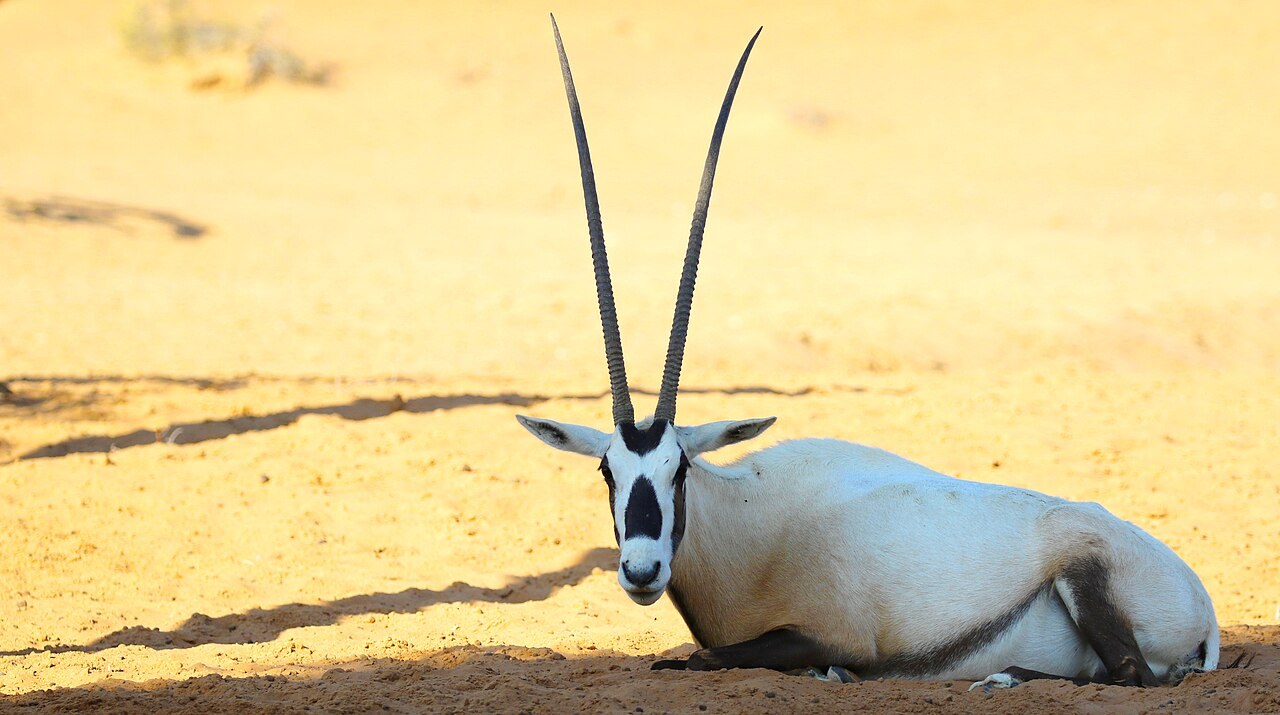
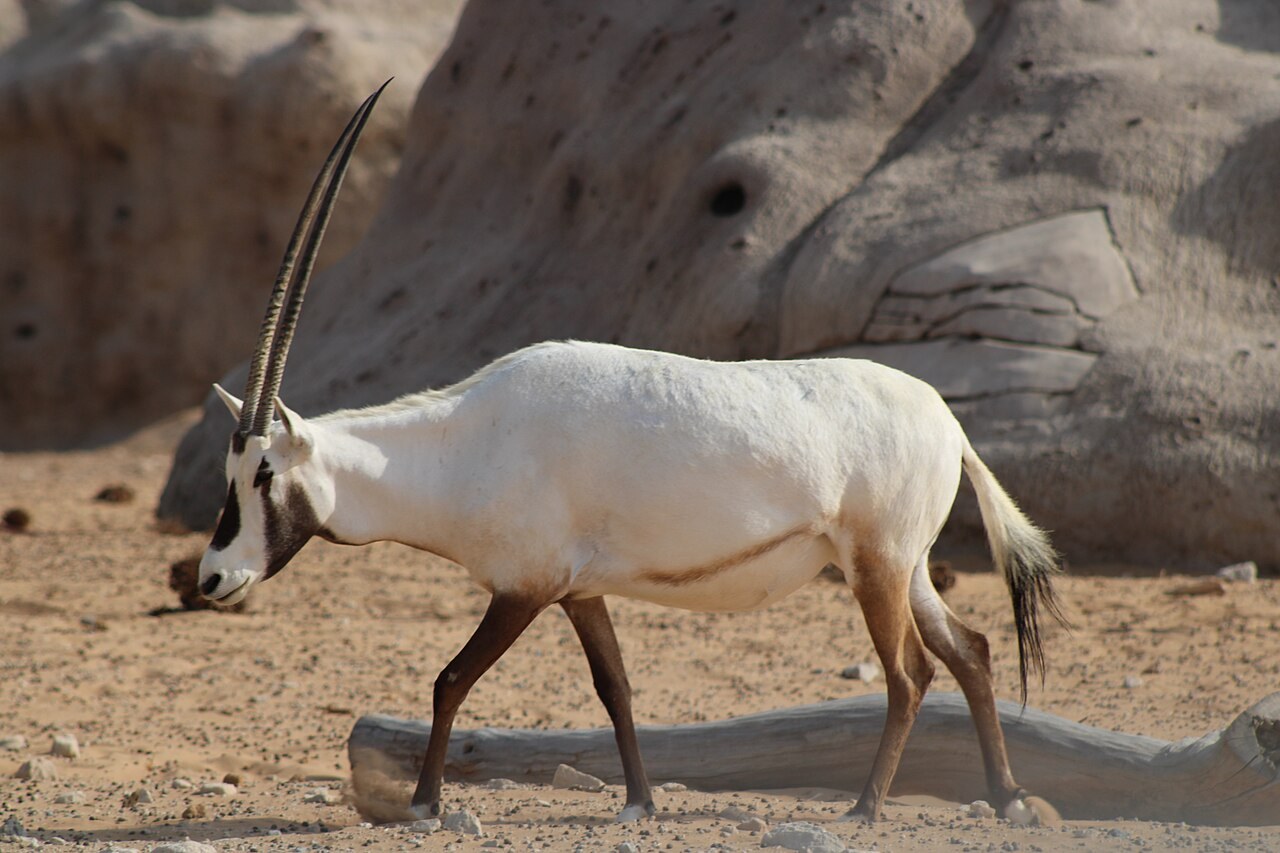
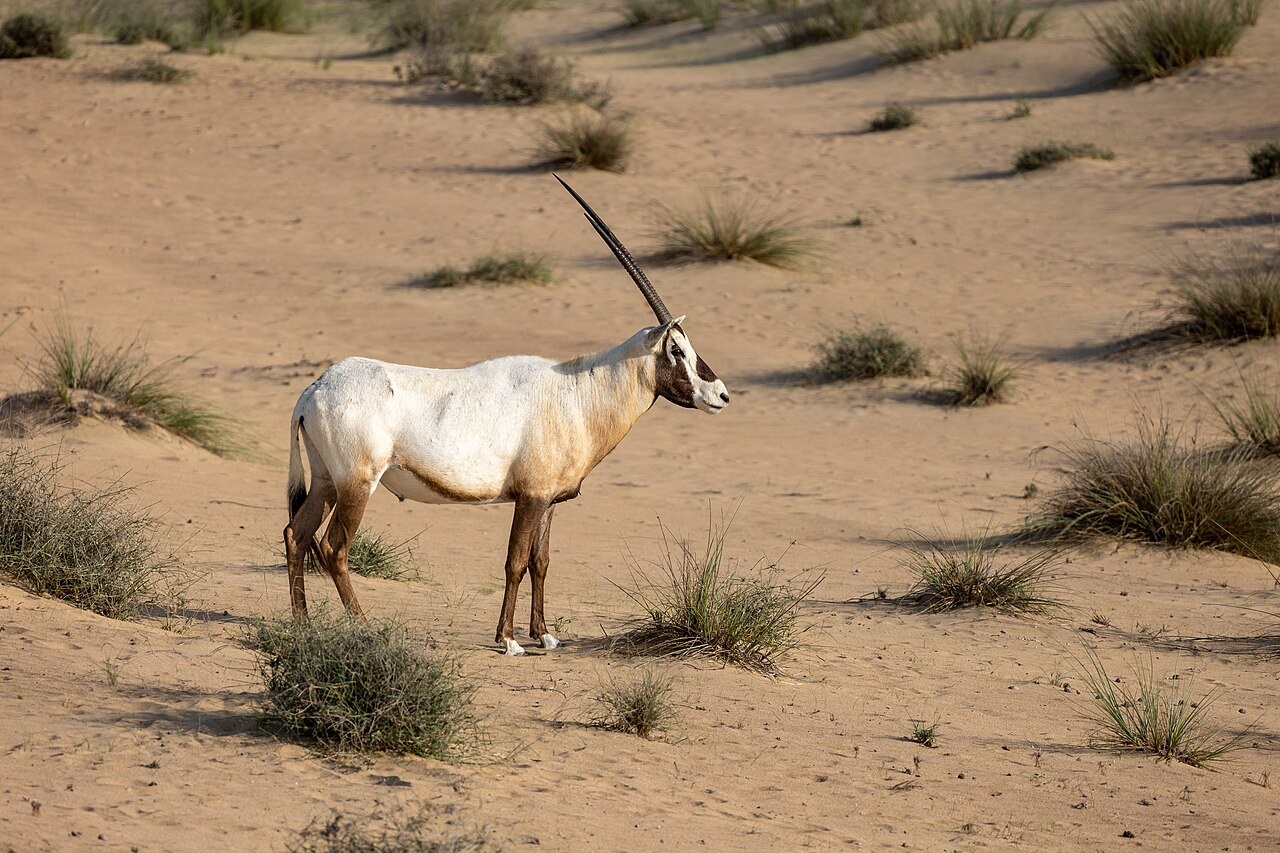
Start with the contrast between the white body and dark markings. Then look at the long horns rising above the head. EAD describes them as straight or slightly curved, with males tending to have thicker, shorter horns than females. Both sexes carry horns, so their presence alone does not identify a male.
The broad hooves also matter. EAD notes that they help movement on soft sand. In a photograph, however, the feet may be hidden by vegetation or the slope of a dune. Use several features together rather than identifying the animal from a single distant silhouette.
Desert adaptations: coping with heat and cold
A white coat can look conspicuous against a dune, but colour has a practical role. San Diego Zoo Safari Park explains that the pale coat reflects sunlight and desert heat. On cold mornings, the animal can raise its hair to retain warmth in its thick undercoat. Desert survival involves both hot days and cool conditions, rather than heat alone.
Water conservation is another part of the story. Zoo Zurich’s species account describes very dry droppings and concentrated urine as ways of reducing fluid loss. These are physiological adaptations, not evidence that the animal never needs moisture. Avoid treating an impressive adaptation as an unlimited ability to survive drought.
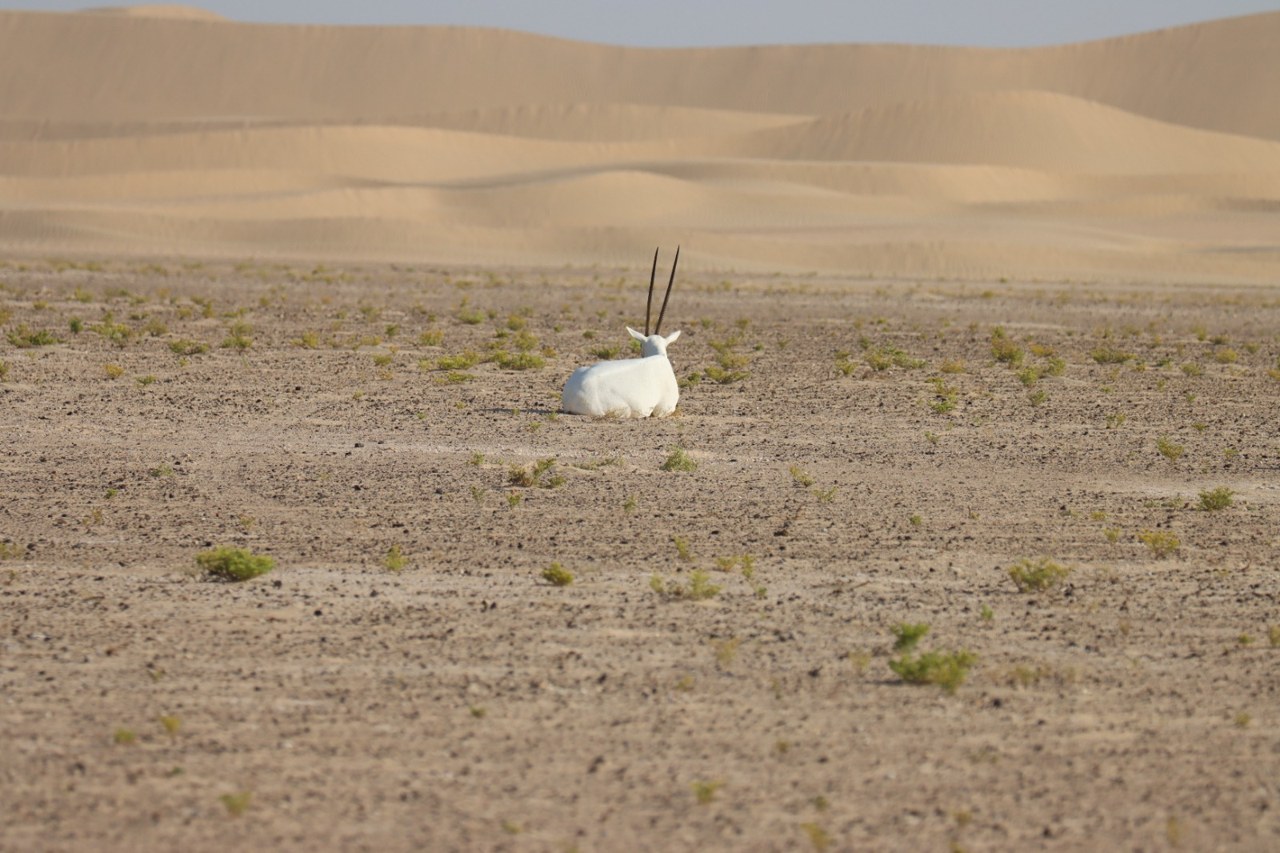
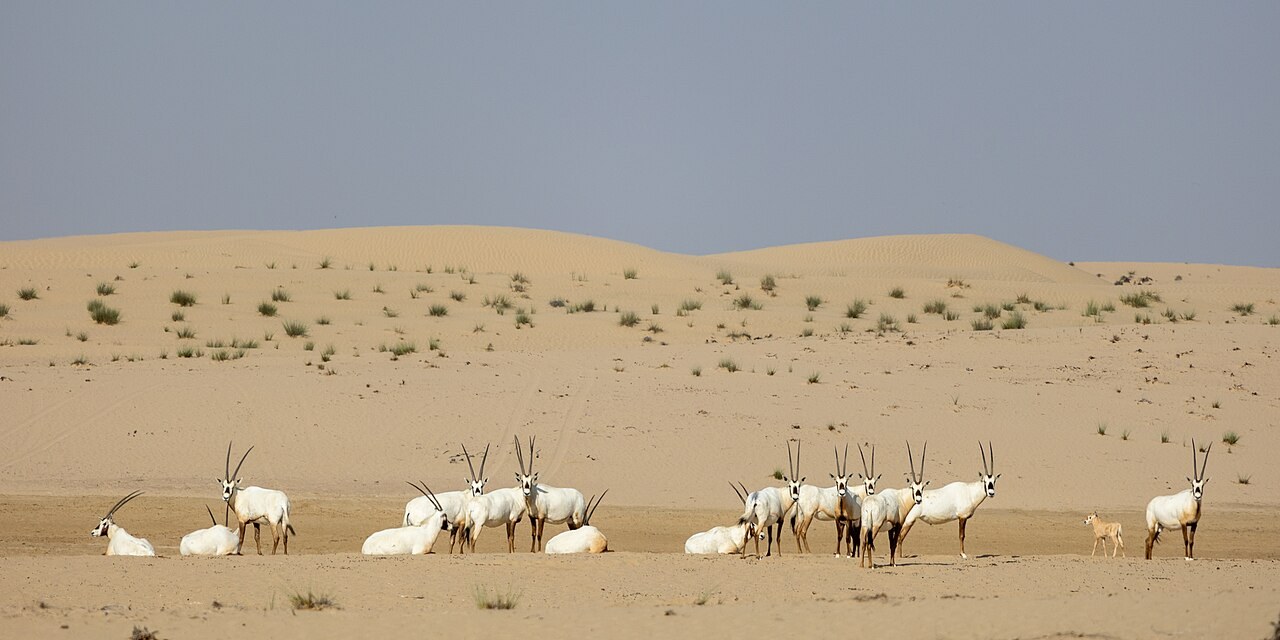
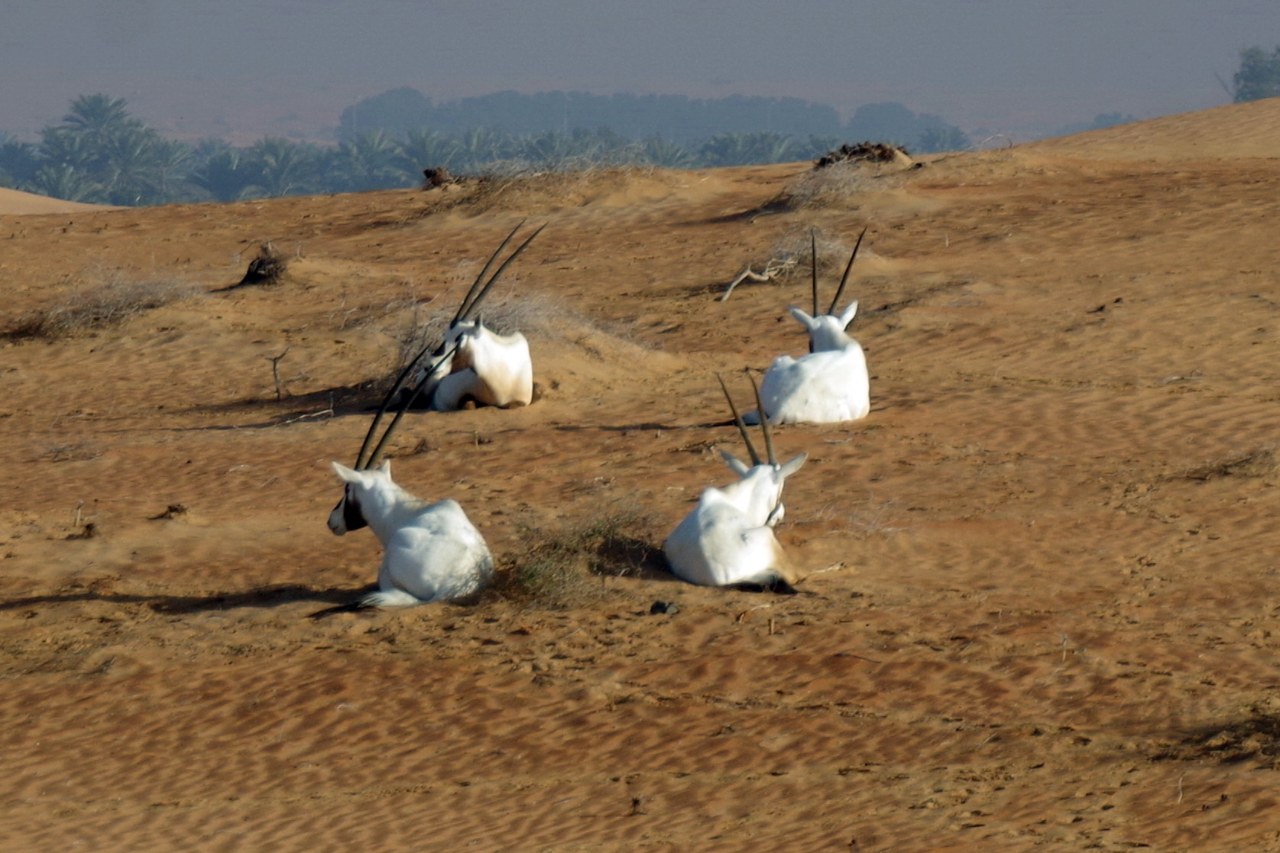
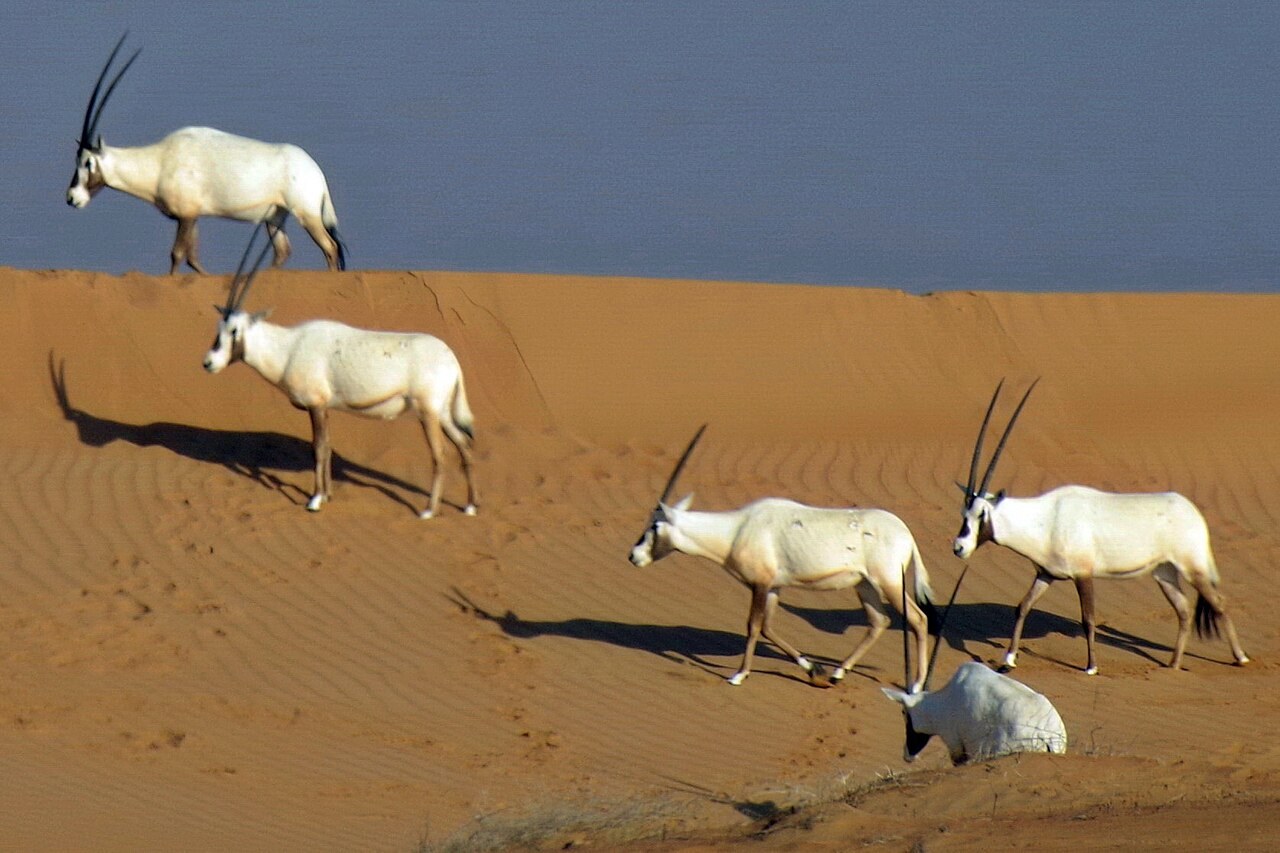
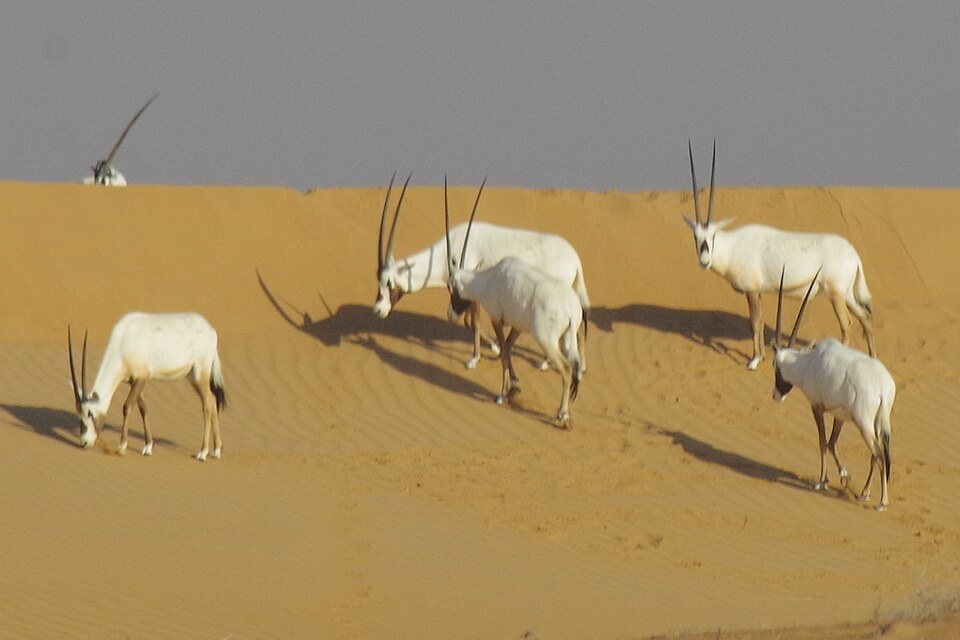
The gallery offers a useful visual comparison: a resting animal, an individual standing among shrubs and groups moving over sand. A still image records one moment; it cannot establish the temperature, water availability or daily routine at that location.
Habitat, vegetation and herd life
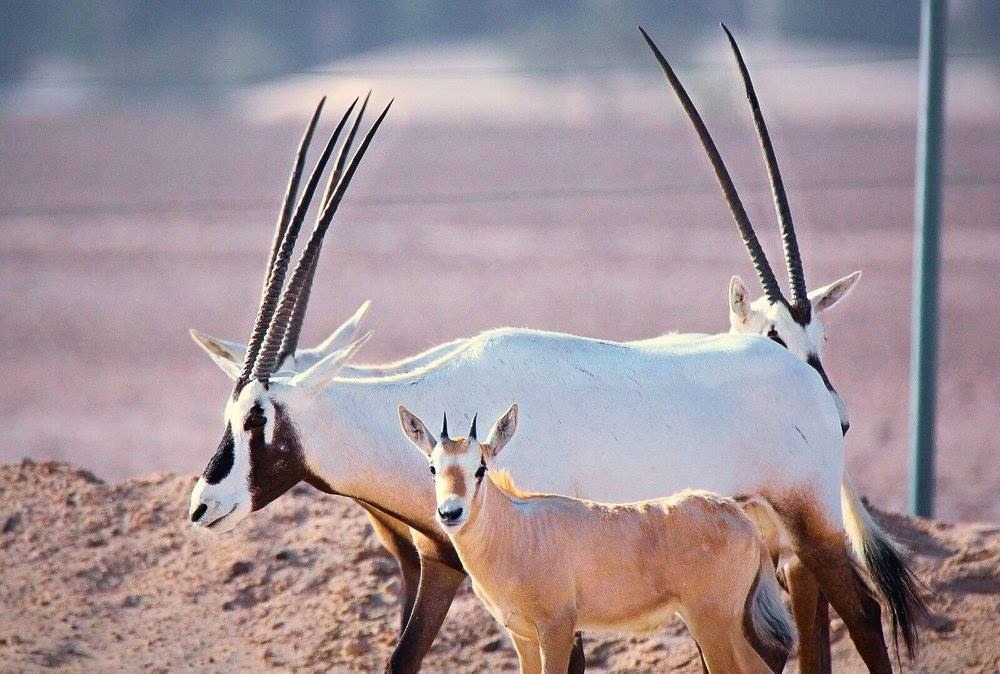
Zoo Zurich places the species in desert and semi-desert habitats and describes foraging where fresh vegetation is available. Its account also records mixed-sex herds, commonly of up to ten animals, with larger groups possible. That helps explain why an oryx may be photographed alone in one scene and beside several companions in another.
The landscape is therefore part of the animal’s story. Open sand, scattered shrubs and patches of growth create different opportunities for movement and feeding. A desert should not be understood as an empty backdrop with no biological resources.
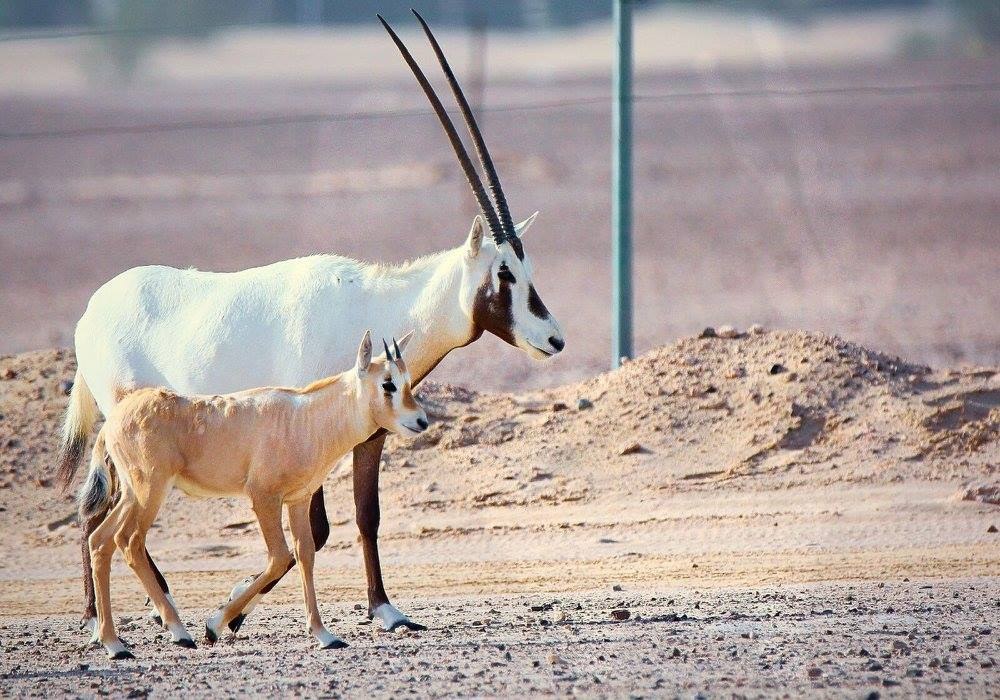
The calf photographs below provide a further comparison. Notice the difference between the calf’s colouring and the adults’ pale coats, as well as the scale of their horns. These are observations of the pictured animals, not a claim that every calf follows the same growth timetable.
From extinction in the wild to a return
In its June 2011 announcement, IUCN reported the Arabian oryx’s move from Endangered to Vulnerable after successful captive breeding and reintroduction. The organisation described an exceptional recovery for a species that had previously been Extinct in the Wild. It also reported that the last wild individual was believed to have been shot in 1972.
The distinction between extinction and extinction in the wild is crucial. Animals surviving under human care made a recovery programme possible. Without those surviving populations, there would have been no living breeding foundation for releases.
San Diego Zoo Safari Park describes its participation in Operation Oryx and the return of animals to Oman and Jordan for reintroduction. The result was an international effort involving institutions and countries, rather than the work of a single place.
Arabian oryx conservation in Abu Dhabi
EAD identifies Qasr Al Sarab Protected Area and the Arabian Oryx Protected Area among the locations associated with the species in Abu Dhabi. Its account connects the recovery with the conservation legacy of Sheikh Zayed bin Sultan Al Nahyan. These are conservation references, not a promise of unrestricted visitor access.
The work also extends beyond national boundaries. In its December 2023 regional update, EAD described coordination among range states and the Sheikh Mohamed bin Zayed reintroduction programme, launched in 2007. The stated aim is to establish viable populations in historical habitats under effective conservation management.
That same dated update reported more than 10,000 animals across range states, including 8,000 in the UAE. These are 2023 survey figures quoted by EAD, not a new census for 2026. Nor should a regional total automatically be presented as the number of free-ranging wild animals: population reports can differ in date, geography and management category.
Why breeding management still matters
Recovery involves more than increasing a head count. A March 2024 Abu Dhabi Media Office report describes Al Ain Zoo’s breeding, veterinary and genetic-management work. It records DNA analysis of the herd, exchange projects and donations of more than 100 animals to local and regional reintroduction projects.
Those activities illustrate the continuing responsibilities behind a conservation success. Breeding decisions, animal health and the suitability of release sites all deserve attention. A species can improve its conservation status while still depending on sustained protection and careful management.
Enjoying wildlife responsibly
Observe from a distance, give animals space to move and follow the rules of the reserve or facility. Avoid feeding, chasing or approaching a calf for a closer photograph. A long lens and patience produce a better wildlife encounter than forcing the animal to react.
For another desert mammal, read our Fennec Fox profile. You can also explore the Bin3aiah Animals archive for more species and habitats.
Arabian oryx photo gallery
Ten credited photographs show individuals, calves and groups in UAE settings. Locations and management settings vary; these images do not all depict free-ranging wild populations. Select a photograph for the larger view. All photographs are CC BY-SA 4.0 and resized proportionally. Featured photograph: Yan Werner.
Watch: Arabian oryx videos
Three archival films explore the species and the role of conservation partnerships. Population figures or project details mentioned in older footage belong to their original reporting dates.
Creature Feature: Arabian Oryx with Phoenix Zoo’s Liesl King
Watch Creature Feature: Arabian Oryx with Phoenix Zoo’s Liesl King on YouTube.
Phoenix Zoo: Arabian oryx conservation work in Jordan
Watch Phoenix Zoo: Arabian oryx conservation work in Jordan on YouTube.
Phoenix Zoo: saving the Arabian oryx
Watch Phoenix Zoo: saving the Arabian oryx on YouTube.
Frequently asked questions
What is the Arabian oryx’s scientific name?
It is Oryx leucoryx, an antelope in the family Bovidae.
Do female Arabian oryx have horns?
Yes. Both sexes carry long horns, although horn proportions can differ.
Is the Arabian oryx still extinct in the wild?
No. Breeding and reintroduction enabled its return. IUCN announced the move to Vulnerable in 2011, and EAD’s species profile lists it as Vulnerable.
Does a conservation success mean the work is finished?
No. The species still needs habitat protection, population management and cooperation among conservation organisations and range states.
Sources and further reading
- EAD: Arabian oryx species profile
- San Diego Zoo Safari Park: adaptations and Operation Oryx
- Zoo Zurich: ecology and conservation
- IUCN: the 2011 recovery milestone
- EAD: December 2023 regional conservation update
- Abu Dhabi Media Office: Al Ain Zoo conservation work, March 2024