
Views: 10
Meerkat: How Desert Families Work Together
WILDLIFE • ANIMAL BEHAVIOR • AFRICAN DESERTS
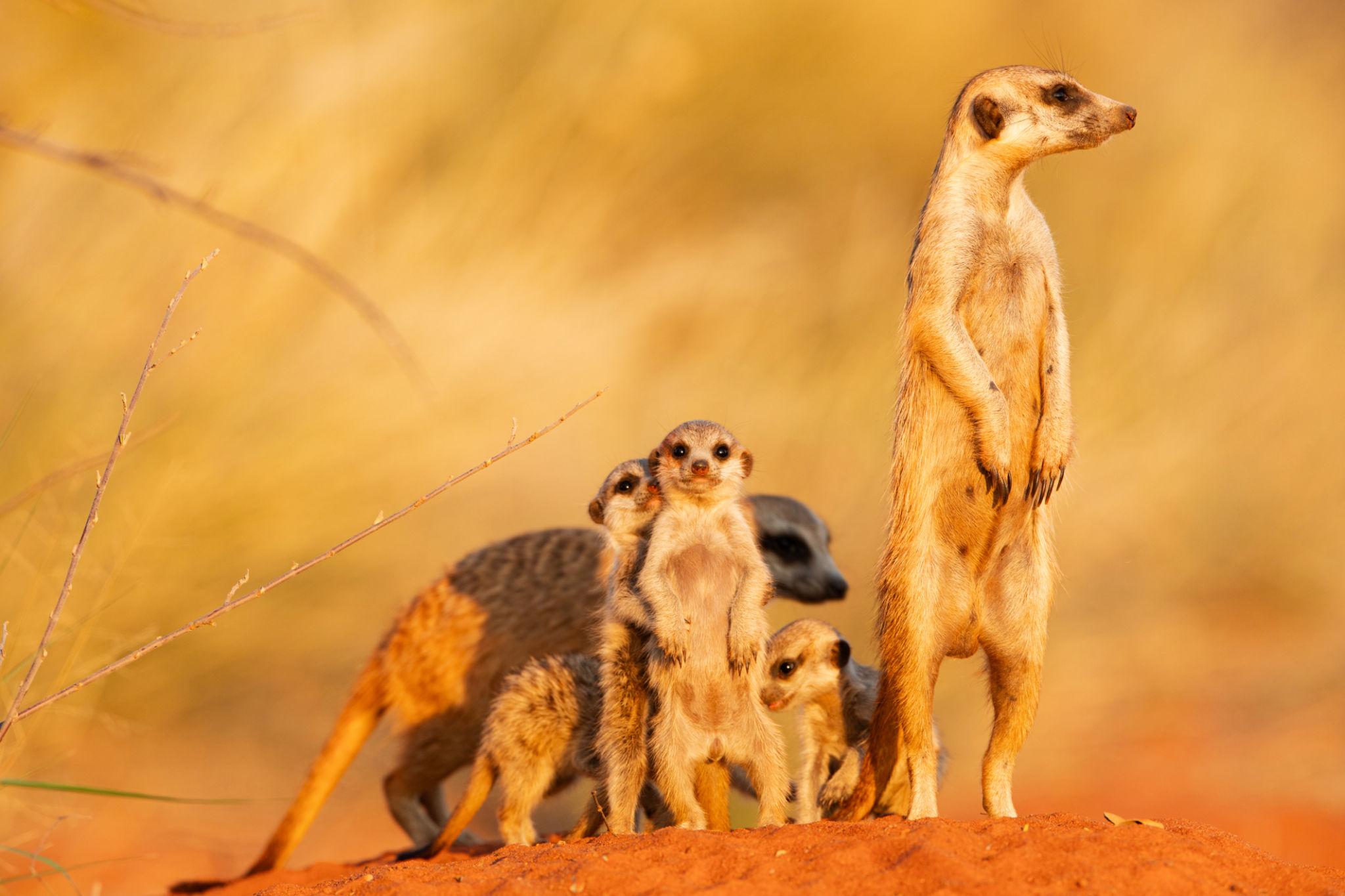
Meerkats, Kalahari Desert, South Africa
Jen Guyton – Kalahari Meerkats
The Dark Side of Cooperation | Research Communities by Springer Nature
9
In the harsh deserts of southern Africa, survival is a family effort. Meerkats have developed a remarkable social system built around teamwork, communication, protection, and shared responsibility.
1. Meet the Meerkat
The meerkat (Suricata suricatta) is a small mammal belonging to the mongoose family. Native to southern Africa, it inhabits dry grasslands, scrublands, and deserts, including the famous Kalahari.
Despite their small size, meerkats are highly organized social animals. They live in groups known as mobs or gangs, sometimes containing up to 40 individuals.
| Characteristic | Details |
|---|---|
| Scientific name | Suricata suricatta |
| Family | Herpestidae (mongooses) |
| Habitat | Deserts, savannas and dry grasslands |
| Body length | Approximately 24–29 cm |
| Weight | Approximately 620–970 g |
| Diet | Insects, scorpions, small reptiles and other foods |
| Social structure | Cooperative family groups |
| Conservation status | Least Concern |
National Zoo+1
2. A Family That Works Together
Meerkat society is organized around a dominant breeding pair, particularly a dominant female. Other group members help support and protect the offspring.
This system is called cooperative breeding.
Members of the mob contribute through several important activities:
- Watching for predators.
- Babysitting young pups.
- Providing food to developing youngsters.
- Maintaining underground burrows.
- Grooming one another and strengthening social relationships.
- Defending their territory against rival groups.
Not every member contributes equally, and meerkat society can also involve competition and conflict. Nevertheless, cooperation plays a central role in group survival. San Diego Zoo Animals & Plants+1
3. The Sentinel: A Desert Security Guard
Meerkat or suricate (Suricata suricatta) on the lookout, Makgadikgadi Pans, Botswana
One of the most recognizable meerkat behaviors is standing upright on the hind legs.
While other members search for food, a lookout known as a sentinel watches for approaching danger.
Potential threats include eagles, hawks, snakes, and other predators.
When a sentinel detects danger, it produces warning calls that help the group respond. Depending on the threat, meerkats may freeze, seek shelter, or rush into their burrows.
Research has shown that helpers increase some lookout behaviors when young pups accompany the group. ScienceDirect+1
4. Raising Babies Is a Group Responsibility
A Conservationist’s Top Six Wildlife Moments in Botswana
Meerkat pups are born small and helpless, with their eyes and ears closed.
As the pups grow, other adults help care for them. Some remain at the burrow as babysitters while the rest of the group searches for food.
Older meerkats also help youngsters learn essential survival skills.
A particularly fascinating behavior is how adults teach pups to handle dangerous prey. They may initially provide a scorpion with its stinger disabled, allowing the young meerkat to practice before facing more challenging prey.
This is an unusual and well-studied example of animal teaching. San Diego Zoo Animals & Plants+1
5. Underground Homes: The Family Fortress
Meerkats spend nights and periods of danger inside underground burrow systems.
These shelters provide protection from predators and extreme weather.
Multiple entrances allow group members to access shelter quickly. Meerkats regularly dig and maintain tunnels, and groups may move between different burrow systems.
During cold mornings, meerkats often emerge to warm themselves in the sunshine before beginning their daily activities.
6. Communication Keeps Everyone Connected
Meerkats use a variety of vocalizations to coordinate activities.
Their communication includes contact calls, alarm calls, and sounds associated with social interactions.
Different warning calls can convey information about the type or urgency of danger.
Communication helps members remain connected even while scattered across the ground searching for food.
7. Why Cooperation Matters
Living together offers several advantages:
- Greater protection: More individuals can detect approaching predators.
- Higher pup survival: Helpers provide additional care and protection.
- Shared knowledge: Young meerkats learn feeding and defensive behaviors.
- Stronger social bonds: Grooming and frequent contact support group cohesion.
- Collective defense: Groups can cooperate when confronting threats.
However, group life also brings challenges, including food competition, dominance struggles, and territorial conflicts.
The meerkat’s success comes not from perfect harmony, but from balancing cooperation with competition.
8. Five Fascinating Meerkat Facts
Inquisitive meerkat standing on a sun-drenched rock, surveying its environment.
Dark eye patches
The distinctive dark markings around their eyes help reduce glare in bright sunlight.
Meerkat digs a deep hole in the sand
Powerful diggers
Strong front claws help them excavate burrows and uncover insects hiding underground.
Exotic Animals / Egzotik Hayvanlar
Scorpion hunters
Meerkats can catch and eat scorpions, though hunting them still involves danger.
Social sleepers
Meerkats frequently huddle together, helping conserve warmth and reinforce social bonds.
Meerkat with babys, Kalahari desert
Female-led societies
A dominant female generally produces most of the group’s young and plays a central role in social organization.
Conclusion
Meerkats demonstrate how cooperation can help small animals survive in challenging environments. From sentinels scanning the horizon to adults teaching pups how to hunt, their daily lives depend on coordination and social relationships.
Their family system is a remarkable example of how evolution has shaped cooperation in the animal kingdom.
WordPress SEO — Bin3aiah Animals
SEO TITLE
Meerkat: How Desert Families Work Together | Bin3aiah Animals
Copy
URL SLUG
meerkat-how-desert-families-work-together
Copy
META DESCRIPTION
Discover how meerkat families survive through teamwork, sentinel guards, shared childcare, communication, and cooperation in Africa’s deserts.
Copy
FOCUS KEYWORD
meerkat family behavior
CATEGORY
Animals / Mammals / Wildlife Behavior
WORDPRESS TAGS
Meerkat, Meerkat Family, Desert Animals, Kalahari Desert, Animal Behavior, Wildlife, Cooperative Breeding, Meerkat Pups, Sentinel Behavior, Mongoose, African Wildlife, Animal Communication
Copy tags
Suggested featured image
Meerkats, Kalahari Desert, South Africa
Image alt text: Meerkat family standing together in the Kalahari Desert with an adult watching for predators and young pups nearby.
Recommended thumbnail dimensions: 1200 × 675 pixels.
Suggested article references: San Diego Zoo — Meerkat and Smithsonian National Zoo — Meerkat.
Publishing note: The article and SEO fields are prepared here; they have not been published to WordPress. Check image licensing before using photographs on your website.