
Views: 1
BIN3AIAH ANIMALS • WILDLIFE & ANIMAL BEHAVIOR
Gray Wolf: Understanding Pack Behavior


11
The gray wolf (Canis lupus) is one of nature’s most fascinating social predators. Known for its intelligence, cooperation, and haunting howls, this remarkable animal survives not simply through strength, but through strong family bonds and teamwork.
A wolf pack is far more than a group of hunters. It is a functioning family in which adults protect their young, experienced members share knowledge, and individuals communicate through an elaborate combination of sounds, scents, and body language.
Understanding wolf behavior reveals a surprising truth: the strength of a wolf pack comes primarily from cooperation, not constant competition for dominance.
1. The social structure of a wolf pack

Most wild wolf packs consist of a breeding pair and their offspring from one or more years. Older offspring may remain with the family, helping care for younger siblings before eventually leaving to form their own packs.
Pack size varies with habitat, prey availability, births, and dispersal. Groups of approximately five to eight wolves are common, although substantially larger packs occur.
The parents generally guide movement, hunting, and protection, but leadership can vary by situation.
International Wolf Center
+1
Is the alpha wolf a myth?
The traditional image of an aggressive alpha male constantly fighting to maintain control is largely misleading.
Early dominance theories were influenced by studies of unrelated wolves living together in captivity. Research on wild wolves, including work by biologist L. David Mech, demonstrated that natural packs are generally families led by parents.
Dominance displays still exist, and some packs have more complicated relationships, but the typical wild pack does not operate through endless violent leadership challenges.
USGS Science
+1
2. How wolves communicate


7
Wolves communicate in several sophisticated ways.
- Howling: Helps separated members locate one another and communicates a pack’s presence to neighboring wolves.
- Growling and barking: Can signal threats, warnings, or agitation.
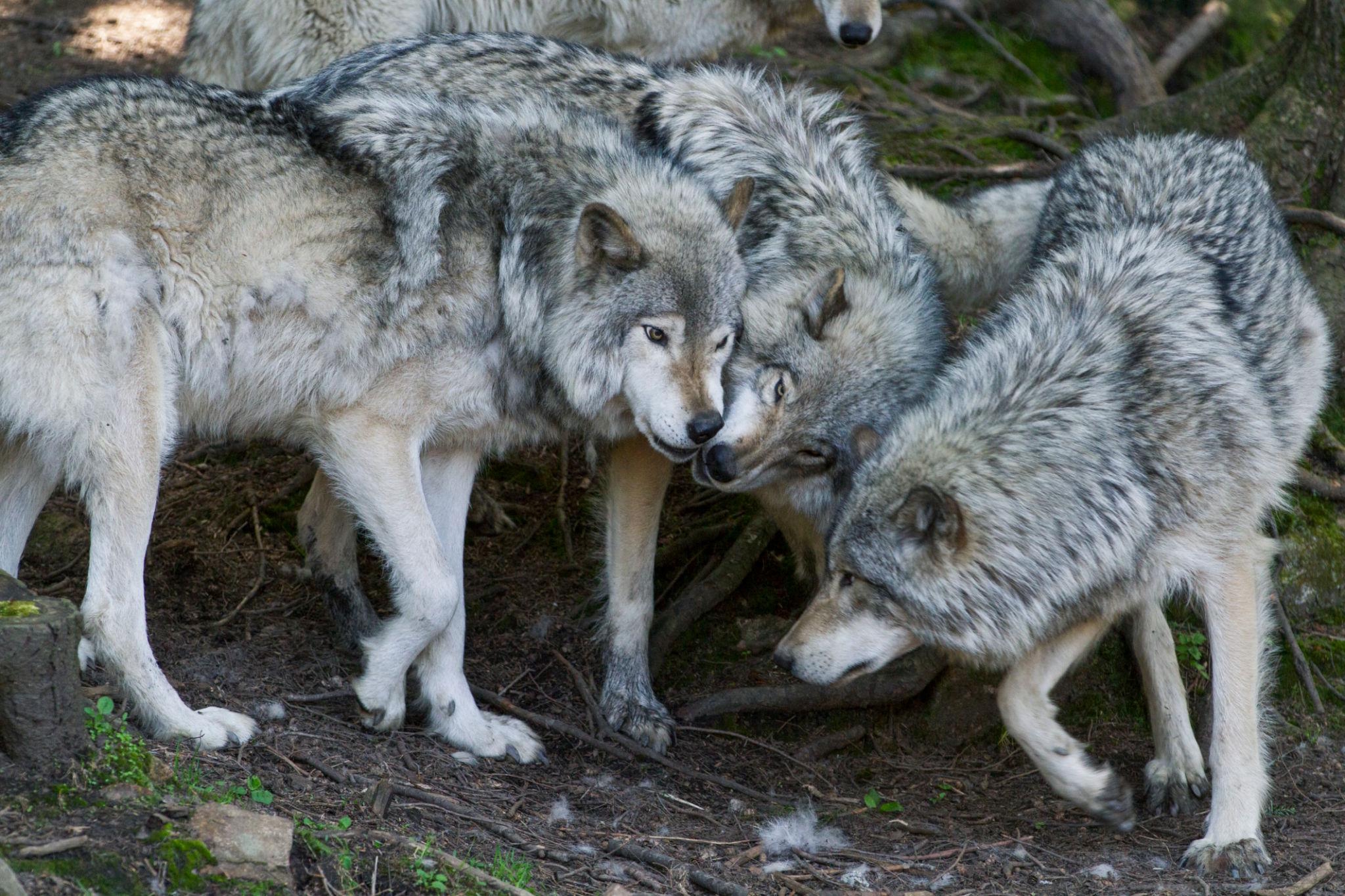
- Body language: Ear position, tail movement, posture, and facial expression communicate emotion and social intentions.
- Scent marking: Urine and other scent signals help wolves establish and maintain territories.
- Physical contact: Muzzle licking, sniffing, play, and greeting behaviors reinforce social relationships.
A wolf’s howl is not necessarily an expression of sadness. It can be a practical long-distance communication signal that helps coordinate the group.
National Zoo
+1
3. Cooperative hunting and survival

Cooperative hunting is among the gray wolf’s most impressive adaptations.
Wolves may hunt deer, elk, moose, caribou, and smaller animals. Group hunting can help them pursue prey much larger than any individual wolf.
During a hunt, wolves assess opportunities, pursue vulnerable animals, and adjust their behavior to changing circumstances. Not every chase is successful, and attacking large hoofed animals can be extremely dangerous.
Importantly, hunting does not always involve a perfectly coordinated strategy with fixed individual roles. Pack members respond dynamically to terrain, prey movement, experience, and opportunity.
Wolves also support their pack through sharing food, defending carcasses, and helping family members survive difficult periods.
National Park Service
+1
4. Raising pups: A family responsibility


10
Wolf pups are generally born in spring following a gestation period of approximately 63 days.
At birth, the pups are blind, deaf, and completely dependent on their mother. As they develop, they begin exploring outside the den, playing with siblings, and learning social behavior.
Other pack members may help provide food, guard the young, and supervise them while the parents hunt.
Play is especially important. Chasing, wrestling, and playful biting help pups develop coordination and social skills that will be valuable in adulthood.
National Zoo
+1
5. Territory and pack boundaries
Gray wolves are territorial animals. Packs occupy and defend areas that provide sufficient food, water, and habitat for raising young.
The size of a territory depends on prey density, geography, and neighboring packs. Wolves use howling and scent marking to communicate territorial boundaries.
Encounters between rival packs can sometimes become aggressive or fatal, particularly when food and territory are contested.
National Park Service
+1
6. Why wolves leave their packs
Young wolves do not necessarily remain with their birth families forever.
As they approach maturity, some individuals disperse, traveling away from their original territory to search for potential mates and suitable habitat.
When two dispersing wolves form a breeding pair and reproduce, a new family pack can begin.
This process contributes to genetic exchange and helps wolves expand into suitable territories.
International Wolf Center
+1
7. Why wolf packs matter to ecosystems

As predators, gray wolves influence prey populations and behavior. Their hunting can affect where herbivores forage, while wolf kills provide food for scavengers such as ravens and other animals.
In Yellowstone, wolf restoration has given scientists an opportunity to study relationships among large carnivores, herbivores, vegetation, and other ecological processes.
However, ecosystem changes are complex. Wolves are an important influence, not the sole cause of every environmental change observed after their return.
National Park Service
+1
8. Five fascinating wolf facts

Wolves howl together
Group howling supports communication and territorial signaling.

Lone wolves are often dispersers
A solitary wolf may be searching for a mate or new territory rather than living permanently alone.

Gray wolves aren’t always gray
Their coats can vary from pale cream to brown, gray, and black.

Older siblings can help raise pups
Pack members other than the parents may contribute to care and food provisioning.

Pack membership changes
Births, deaths, and dispersal mean wolf families naturally grow and shrink.
Conclusion
Gray wolves demonstrate the evolutionary advantages of living in a cooperative social group. Their family structure, sophisticated communication, shared pup care, and flexible hunting behavior make them among the most socially complex wild carnivores.
The real story of the wolf pack is not about an all-powerful alpha ruling through fear. It is about families adapting together to survive in challenging environments.
Video gallery

1. Wild Wolves: Pack Life
National Geographic Animals • Full documentary
Wild wolf families, pack relationships, and survival in Yellowstone.

2. Chorus of Wolves
US National Park Service • 1 min 25 sec
An authentic recording of wolves howling near an elk carcass.

3. Wolf Chasing an Elk
US National Park Service
Real footage demonstrating predator-prey interactions.
SEO and WordPress publishing package
ANIMAL — Gray Wolf
Content prepared
SEO TITLE
Gray Wolf Pack Behavior: Family, Hunting & Communication
URL SLUG
gray-wolf-pack-behavior Copy
META DESCRIPTION
Discover how gray wolf packs work, including family roles, hunting strategies, howling, communication, pup care, and the truth about alpha wolves.
CATEGORY
Wildlife / Mammals / Animal Behavior
FOCUS KEYWORD
Gray wolf pack behavior
SUGGESTED TAGS
Gray Wolf, Canis lupus, Wolf Pack, Wolf Behavior, Wildlife, Animal Communication, Yellowstone, Predators
For the featured image, use a genuine photograph of several wild gray wolves moving together through a snowy landscape. Suggested alt text: Gray wolf family pack traveling together through a snowy wilderness.
For the required 10-image gallery, the article above provides visual references covering pack movement, parents, pups, howling, hunting, social interactions, and habitat. Actual publication images should be sourced with permission or suitable licenses from the Wikimedia Commons wolf pack collection and Yellowstone National Park wolf media library. Check each file’s individual usage rights before uploading.
Research sources: International Wolf Center, National Park Service – Wolf Ecology, Smithsonian National Zoo and L. David Mech’s wolf-pack research.
The article and SEO material are prepared for animals.bin3aiah.net. This is a content package, not a published WordPress post; image licenses, uploads, and live publication remain to be completed.