


Views: 2
Sloth: Why Life in the Slow Lane Works
Fortuitous discovery | Smithsonian Tropical Research Institute
Esta es la razón por la que el perezoso es tan lento
9
Sloths are among the slowest mammals on Earth, but their unhurried lifestyle is a remarkable evolutionary adaptation. Living high in the tropical rainforests of Central and South America, these fascinating animals demonstrate that survival does not always depend on speed or strength. Sometimes, conserving energy is the winning strategy.
Why Are Sloths So Slow?
Sloths primarily eat leaves, which provide relatively little energy and take a long time to digest. Rather than burning energy through constant movement, sloths have evolved an exceptionally slow metabolism.
According to the Smithsonian’s National Zoo, some sloths have metabolic rates only about 40–45% of what would normally be expected for mammals of their body weight. National Zoo+1
Their energy-saving adaptations include:
- Slow movement: Reduces energy consumption.
- Specialized digestion: Allows them to process tough plant material.
- Low muscle mass: Reduces metabolic demands.
- Variable body temperature: Helps minimize the energy required to stay warm.
- Limited travel: Reduces unnecessary movement through the rainforest.
Life Upside Down
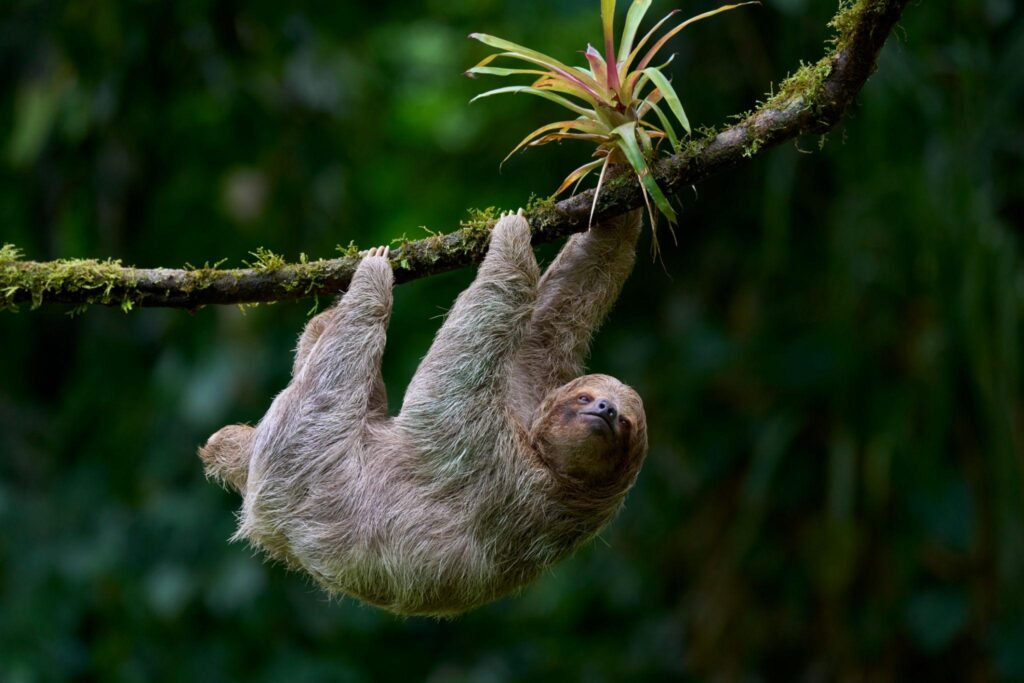
Sloths spend most of their lives hanging from branches. Their long, curved claws provide a secure grip, allowing them to feed, rest, sleep and even give birth while suspended in trees.
They are also surprisingly capable swimmers, despite being awkward movers on the ground.
A Living Ecosystem in Their Fur
One of the sloth’s most unusual adaptations is its fur.
Algae can grow in specialized grooves along its hairs, giving the animal a greenish appearance that helps it blend into the forest canopy. Its fur also provides habitat for moths, beetles, mites and other small organisms.
This makes a sloth more than just a rainforest mammal: it is a tiny, moving ecosystem. National Zoo+1
Sloth Facts at a Glance
| Feature | Details |
|---|---|
| Scientific groups | Bradypus and Choloepus |
| Habitat | Tropical forests of Central and South America |
| Diet | Mainly leaves, with some fruits and shoots |
| Lifestyle | Primarily tree-dwelling |
| Movement | Extremely slow and deliberate |
| Digestion | Can take weeks |
| Main predators | Harpy eagles, jaguars and other predators |
| Defense | Camouflage, stillness, claws and teeth |
Are Sloths Endangered?
Conservation status varies by species. Habitat loss, forest fragmentation, wildlife trafficking and human infrastructure create significant dangers for sloths.
Protecting connected rainforest habitats is especially important because sloths depend on trees for food, movement and shelter.
Conclusion
Sloths prove that being slow is not necessarily a disadvantage. Their unusual metabolism, specialized claws, camouflage and careful energy management have allowed them to thrive in tropical forest ecosystems.
Their greatest evolutionary advantage is not speed, but efficiency.
WordPress SEO
SEO title: Sloth: Why Life in the Slow Lane Works
Slug: sloth-why-life-in-the-slow-lane-works
Meta description: Discover why sloths move so slowly, how they conserve energy, survive in rainforests, and use unique adaptations to thrive.
Category: Animals / Mammals / Wildlife
Focus keyphrase: Sloth adaptations
Secondary keywords: Why are sloths slow, sloth facts, sloth habitat, sloth metabolism, rainforest mammals, sloth conservation
Tags: Sloth, Wildlife, Rainforest, Mammals, Nature, Animal Facts, Evolution, Adaptations, Biodiversity, Tropical Forest, Conservation, Slow Animals
Featured image alt text: Three-toed sloth hanging upside down from a branch in a tropical rainforest
Suggested authoritative references: Smithsonian National Zoo – Sloth Facts and Smithsonian Tropical Research Institute – Life in Slow Motion.