


Views: 0
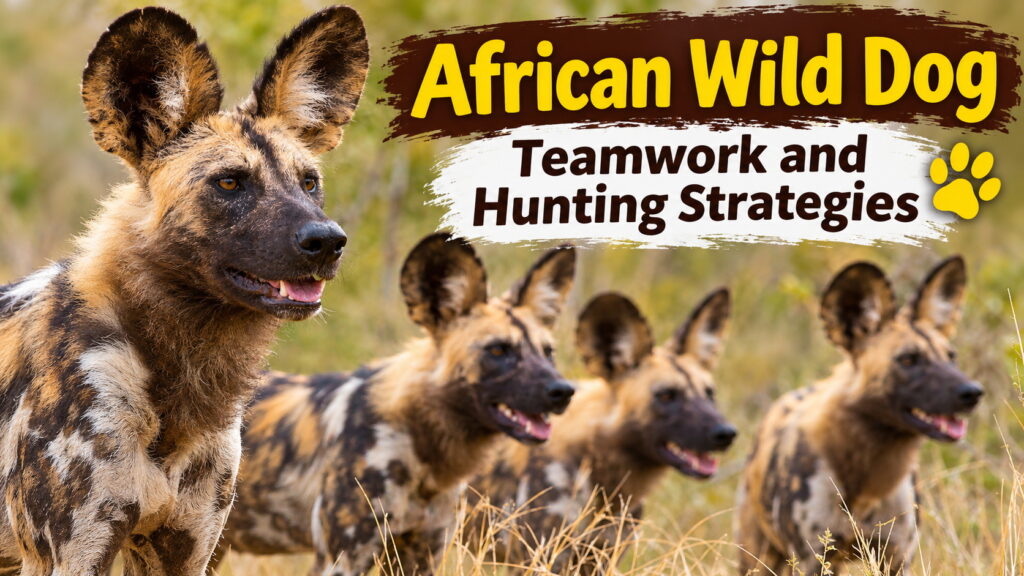
African Wild Dog: Teamwork and Hunting Strategies
The African wild dog (Lycaon pictus), also known as the painted dog or painted wolf, is one of Africa’s most fascinating predators. With distinctive multicolored fur, large rounded ears, and a highly cooperative social structure, this endangered species provides a remarkable example of teamwork in nature.


1. What Makes African Wild Dogs Unique?
African wild dogs belong to the family Canidae, which also includes wolves, foxes, and domestic dogs. However, they are a distinct species with specialized adaptations for living and hunting in African landscapes.
Their long legs, lightweight bodies, powerful muscles, and excellent stamina help them capture fast-moving prey. Their large ears provide sensitive hearing and assist with heat regulation.
Each African wild dog has its own distinctive coat pattern, consisting of irregular patches of black, brown, yellow, and white. These patterns can help wildlife researchers identify individual animals.
| Characteristic | Details |
|---|---|
| Scientific name | Lycaon pictus |
| Family | Canidae |
| Average weight | Approximately 18–36 kg |
| Habitat | Savannas, grasslands, and woodlands |
| Diet | Carnivorous |
| Conservation status | Endangered |
2. How African Wild Dogs Hunt
African wild dogs are skilled hunters, but their methods vary depending on habitat and prey. In open grasslands, packs have been observed pursuing animals over considerable distances. In woodland savannas, research has documented frequent, short, high-speed chases.


Finding and Pursuing Prey
Pack members move across their territories searching for animals such as impalas, gazelles, and other antelopes. When suitable prey is encountered, one or more dogs may accelerate into a chase.
Speed and Persistence
The African wild dog’s athletic body enables rapid acceleration and sustained movement. Its success depends not only on speed but also on repeated hunting opportunities and efficient use of energy.
Hunting Together Without Fixed Roles
Although group hunting is central to their survival, African wild dogs do not always use elaborate formations or assigned roles. GPS research on a pack in northern Botswana found that individual dogs frequently attempted short chases, while the pack benefited collectively from successful captures and food sharing.
This distinction is important: teamwork can be highly effective even when the hunters are not coordinating every movement.
3. Why Teamwork Matters


African wild dogs are intensely social animals. Packs commonly contain a breeding pair, their offspring, and other adult members. Their cooperative relationships support activities far beyond hunting.
- Food sharing: Successful hunters help feed other pack members.
- Collective protection: Adults help defend vulnerable puppies and denning areas.
- Cooperative parenting: Several adults contribute to caring for young animals.
- Social communication: Vocalizations and physical greetings maintain pack cohesion.
- Support for dependent members: Adults can provide food to pups and individuals remaining at the den.
Pack cooperation allows African wild dogs to survive challenges that would be more difficult for solitary animals.
4. Raising Puppies as a Team
One of the most remarkable aspects of African wild dog society is cooperative breeding. The breeding female usually produces the pack’s principal litter, while other adults assist in raising the puppies.


During the denning period, some adults hunt while others remain with the puppies. Returning hunters can regurgitate food for the young and their caregivers, helping distribute nutrition across the pack.
Because raising a litter requires considerable energy, a strong social group can improve the chances that puppies receive adequate nourishment and protection.
5. Communication and Pack Behavior
African wild dogs use a combination of sounds, facial expressions, body postures, and physical contact to communicate.
Their vocalizations include high-pitched contact calls, whining, and alarm signals. Pack members often gather in enthusiastic greeting ceremonies before becoming active or moving together.
Researchers have also investigated sneezing-like sounds associated with group movements. These behaviors illustrate how social signals can influence collective activity.
6. What Do African Wild Dogs Eat?
African wild dogs are carnivores that primarily feed on medium-sized mammals. Their preferred prey depends on geography, habitat, and local availability.
Typical prey animals include:
- Impalas
- Gazelles
- Other medium-sized antelopes
- Occasionally warthogs
- Young wildebeest and other suitable ungulates
Hunting success varies considerably. It is misleading to assign a single success rate to every African wild dog population. Research in Botswana showed that individual chasing attempts were frequently unsuccessful, yet food sharing helped make collective hunting economically valuable for the pack.
7. Rest, Social Bonds, and Daily Life


Although these animals are famous for energetic chases, rest is an equally important part of their lifestyle. Packs often rest together during warm periods, conserving energy and maintaining social contact.
Their daily routine typically alternates between resting, traveling, social interaction, and hunting. African wild dogs are often most active during the cooler parts of the day.
8. Threats to African Wild Dog Survival
Despite their sophisticated social behavior and hunting abilities, African wild dogs remain endangered.
Their most serious threats include:
- Habitat fragmentation: Roads, settlements, and agricultural development divide their territories.
- Human-wildlife conflict: Wild dogs may be killed when perceived as a threat to livestock.
- Infectious diseases: Rabies and canine distemper can seriously affect populations.
- Accidental trapping: Snares intended for other wildlife may injure or kill wild dogs.
- Loss of connectivity: Isolated populations face difficulties exchanging individuals and maintaining healthy genetic diversity.
Protecting large, connected landscapes and reducing preventable human-related deaths are essential conservation priorities.
9. Fascinating African Wild Dog Facts
- No two African wild dogs have exactly the same coat pattern.
- They possess four toes on each foot, unlike most domestic dogs.
- Their scientific name refers to their painted appearance.
- They use social greetings and vocal signals to maintain pack relationships.
- Adults regularly cooperate to feed and protect puppies.
- They are native to sub-Saharan Africa.
- They belong to the dog family and are not hyenas or feral domestic dogs.
Conclusion: The Power of Cooperation
The African wild dog demonstrates how cooperation can support survival in demanding environments. From sharing food and caring for puppies to searching for prey and maintaining social connections, these remarkable predators rely on strong relationships within their packs.
Scientific research also reveals that their hunting behavior is more adaptable and complex than the popular image of a perfectly coordinated pursuit. Different environments encourage different strategies, while social cooperation remains a defining feature of their lives.
Protecting African wild dogs is important not only for conserving an endangered predator but also for preserving one of nature’s most compelling examples of teamwork.